How to Plan Patrol Routes for a Guard Tour System: Checkpoints, Intervals and Schedules
A patrol route is only as good as its plan. This guide walks through laying out routes from scratch: which locations deserve a checkpoint, how many points one route can carry, how to set patrol intervals and rest time, how routes share checkpoints without clashing, and the planning mistakes that show up later as missed points.
A guard tour system is honest about one thing: it records exactly what the route asks it to record. Plan the route badly and the reports will nag about missed points that nobody could ever have reached; plan it well and the same reports become the cleanest management tool on site. This guide covers the practical decisions - where checkpoints go, how many a route should carry, how to set intervals a guard can actually keep, and how several routes share one busy building without colliding.
Start from what must be checked, not from the map
The common mistake is to walk the site with a floor plan and put a checkpoint wherever there is a wall. The better order is the reverse: first list what actually needs proving - the entrance that must be locked, the pump room, the fire exits, the cash office, the loading bay - then find a mounting spot for each of those, and only afterwards look at whether the path between them makes a walkable route. A checkpoint that exists because a wall was free gets scanned out of habit and proves nothing.
How many checkpoints one route can carry
Most routes we see carry between 10 and 30 checkpoints, and the honest constraint is not the reader - it is attention. A guard touching one point every one to two minutes stays alert for the full round; a route padded to 60 points turns scanning into a reflex. A simple test: if a point has no reason of its own - a door, a device, a risk - leave it out. Fewer, better-argued points produce reports that people actually read.
- Give every checkpoint one job: a lock, a meter, a risk, or an area that must be seen.
- Keep 1 to 2 minutes of walking between points so the timestamps breathe naturally.
- Mount at chest height near the thing being checked, not around a corner from it.
- Shelter outdoor tags from driving rain and ice, and use anti-metal versions on steel posts.
- Add about 10 percent spares when ordering, for damage and for new points added later.
One route or several
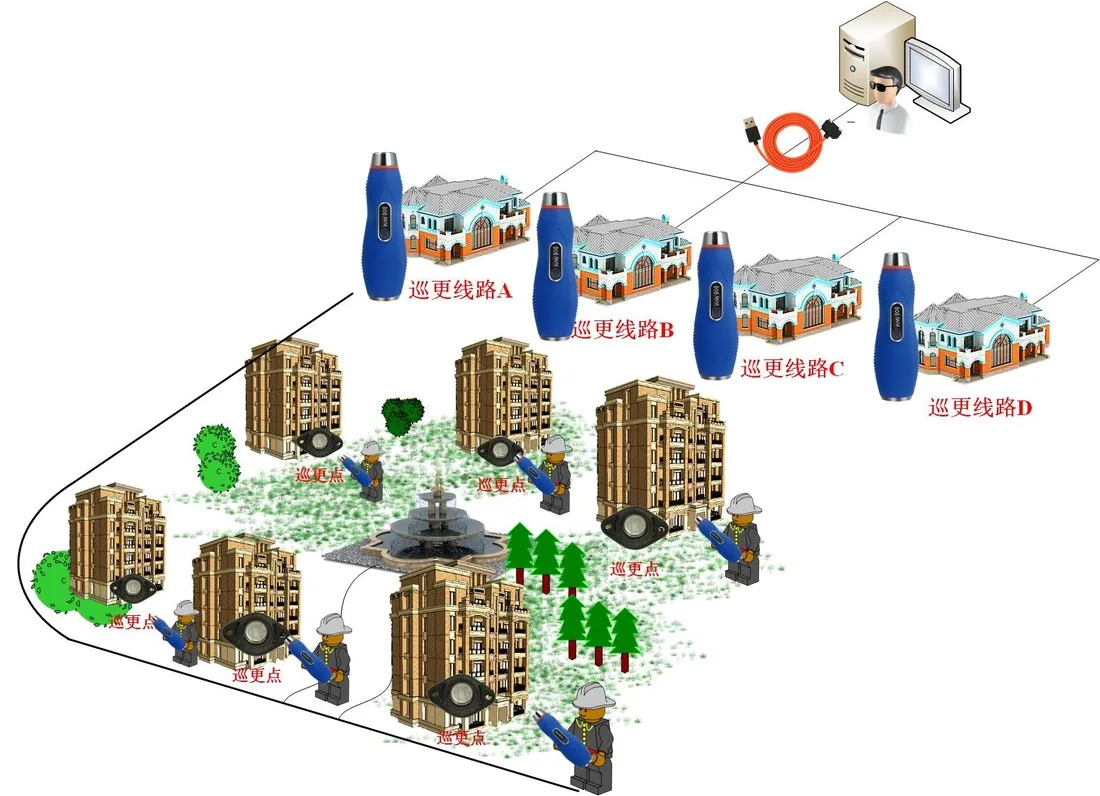
Split into separate routes when the site has separate rhythms: day shift and night shift, office floors and warehouse, one building and another. As a working rule, one guard should be able to finish one route comfortably inside a single patrol window. A point may belong to more than one route - the same fire exit can sit in the day route and the night route - but when two routes share points, their patrol time windows must not overlap, otherwise two guards arrive at the same door at once and both records argue about who was there.
Set intervals a guard can actually keep
An interval is the time window of one complete patrol; the gap between two patrols is rest time. The reliable way to size them is to walk the route once and time it, then set the interval at roughly one and a half times the measured walk - night rounds slow down for doors, lifts and dark stairwells. Plans usually run from the current day onward with no end date, repeating on schedule, with rest days set by weekday. A plan of 00:00 to 24:00 with an interval of every 2 hours simply means: patrol around the clock, one full round every two hours.
| Planning item | Example value | Why |
|---|---|---|
| Patrol window | 00:00 - 24:00 | The route must be walkable at any time of day or night |
| Interval | Every 2 hours | One full round about every two hours, sized from the measured walk time |
| Measured walk time | About 40 minutes for 18 checkpoints | The interval must be at least 1.5 x this, or every round starts late |
| Rest time | 30 minutes between rounds | Fixed by the difference between interval and walk time |
| Rest days | By weekday, set in the plan | Office sites often skip Sundays; warehouses rarely rest |
Keep the judgement loose on purpose
A guard tour system does not need the guard to walk in the listed order, and it does not mark anyone late for reaching a point a few minutes outside a target. The only flag the report raises is a missed point - a checkpoint in the plan that was never scanned inside the window. This looseness is deliberate. Real buildings lock doors, breaks run long, lifts get busy; a system that punishes every deviation trains guards to manipulate the report instead of walking the route. Presence is the fact that matters, and presence is what the record proves.
Planning mistakes that turn into missed points
- Intervals set tighter than the real walk time, so every round is born late.
- Checkpoints behind doors that are locked outside office hours, with no key plan.
- One shared point placed in two routes whose windows overlap, so the records collide.
- Tags mounted where weather, forklifts or renovation work destroy them mid-season.
- No spare tags and no spare guard key on site, so one broken plate stalls the whole route.
- A route edited after go-live without telling the guards, who keep walking the old line.
From plan to first report
The path from floor plan to first clean report is short. Register the checkpoints in the Guard tour management System with the names the site actually uses, mount the tags, bind one guard key per person, and assign the routes and the schedule. Then walk one pilot round before the system goes live: the pilot shows which points were placed badly, which interval does not fit reality, and which door needs its own arrangement - all fixable in software before the first real shift depends on the report.
Frequently asked questions
How long should one patrol interval be? Long enough that a guard can walk the whole route at an honest pace, plus margin - in practice about 1.5 times the measured walk time. A two-hour interval around the clock covers most industrial sites; a corridor-heavy office may run three to four hours. The interval is a management decision; the system simply records whether it was kept.
Can one checkpoint belong to two routes? Yes, and it often does - a main entrance may sit in the day, night and weekend routes at once. The only rule is that the patrol time windows of the routes sharing it must not overlap, so two guards never owe the same door at the same moment.
Do checkpoints have to be scanned in the listed order? No. The report counts each planned point as completed or missed within the window; the walking order is the guard's to choose, because on a real site the order changes with doors, weather and incidents.