
Waterproof, dust-proof and crush-resistant guard tour readers
A guard tour reader lives in a pocket, a glovebox, a plant room and a rainy car park for years. These are the four things that decide whether it still works in year five — and the photos below are our own test shots, not renders.
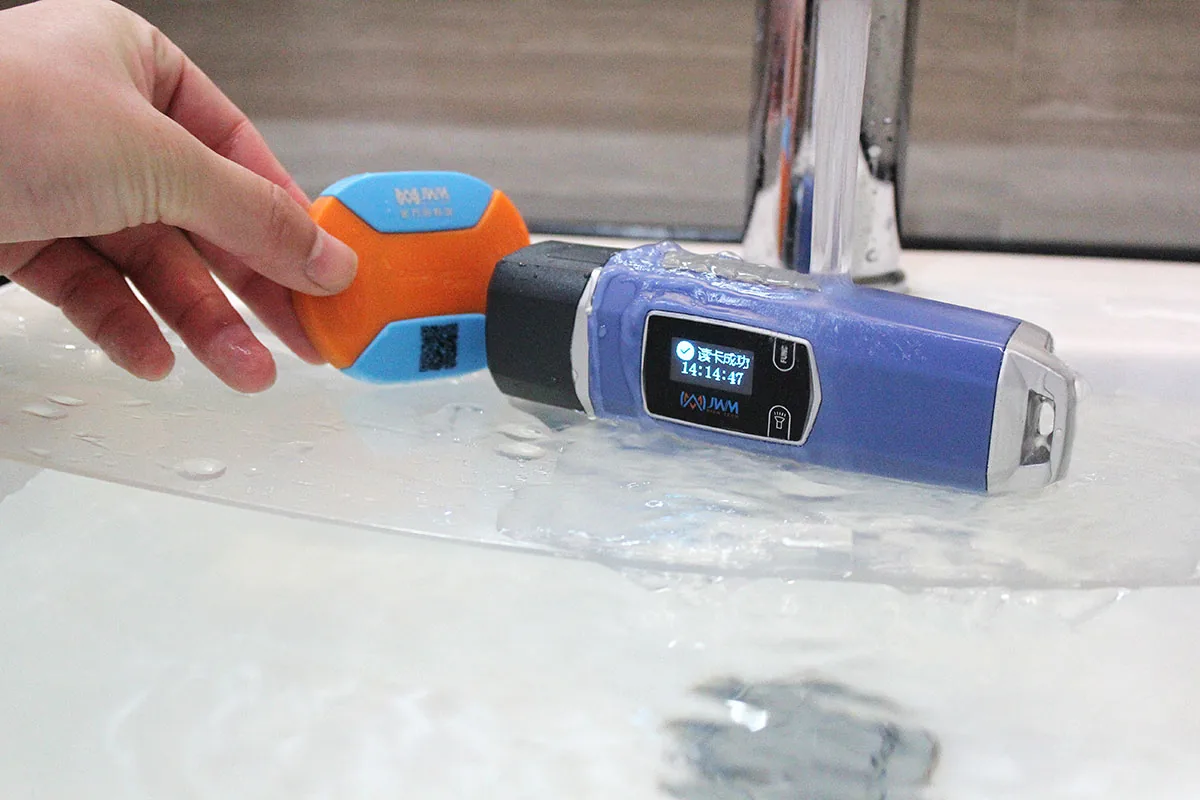
Water: it keeps reading under a running tap
This is the test we run in front of visitors: the reader goes under a running tap, and the guard reads a checkpoint button while the water is still falling on it. The screen in the photo reads 14:14:47, read successful. Nothing was dried out first, and nothing was switched off.
IP67 is the number behind that: 6 for dust — no dust ingress at all — and 7 for water, meaning the housing survives immersion to 1 m for 30 minutes. It is a rating under IEC 60529, so it can be tested by a third party rather than taken on trust.
Where water actually gets in is never the plastic. It is the seams: the battery lid gasket, the USB port cover, the joint between the two housing halves. That is why the sealed models use a gasket rather than a snap-fit lid, and why the USB port on the cable models sits behind a rubber plug.
- ✓Immersion to 1 m for 30 minutes
- ✓No dust ingress at all (class 6)
- ✓Rain, wash-down splash and hose spray
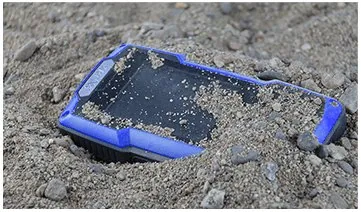
Dust and grit: buried in gravel, then wiped and used
A construction site, a quarry, a cement plant or a grain store will fill an unsealed reader within a season. The grit does not usually kill the electronics directly — it works its way into the keypad, the charging contacts and the USB port, and then the reader starts missing reads or refusing to charge.
In the photo the unit is half buried in gravel and sand. It gets dug out, wiped on a sleeve and put back to work — that is the whole maintenance procedure. No cleaning kit, no drying, no disassembly.
The seal is what makes that possible, and the seal is a physical part: an O-ring or a moulded gasket under compression. That is also the part that ages. On a site with heavy grit, plan on replacing the battery-lid gasket when you replace the battery, not after the reader has already leaked.
- ✓No dust ingress (IP6X)
- ✓Grit cannot reach the keypad or contacts
- ✓Clean with a wipe, not a wash-down kit
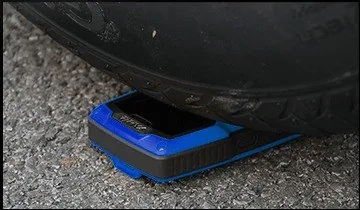
Crush: a car tyre parks on it
The photo is a JWM photo guard tour reader on asphalt with a car tyre resting on it — the sort of accident that happens when a reader is left on the ground next to a vehicle and nobody notices. The housing is moulded so the load lands on the frame, not on the display.
On the WM-5000V+ we quote 100 kgf of static crush, which is roughly an adult standing on the reader or a loaded pallet trolley crossing it. That figure is a static load. A hammer blow is an impact, and no figure on this page will save a reader from one.
What the rating really buys you is that the ordinary accidents of a night shift stop being purchases: standing on it, dropping a toolbox on it, running a trolley over it. Those are the failures a crush rating is designed for.
- ✓100 kgf static crush on WM-5000V+
- ✓Load carried by the frame, not the screen
- ✓Static load — not a hammer rating
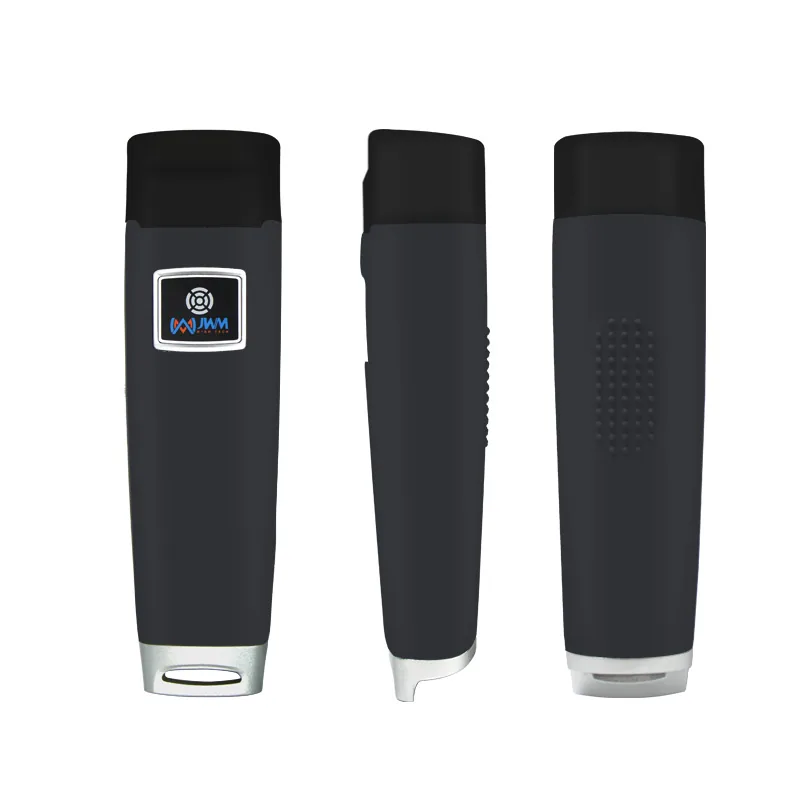
Dropping: from belt height to a 30 m fall
The WM-5000V+ is rated for a 2 m drop onto concrete, which is above waist height — the drop that happens when a clip gives way on a stairwell. The WM-5000L3, built on a heavier online platform, is rated to 30 m.
The structure behind it is the same on both: a rubber jacket over a metal core. The rubber takes the impact and gives grip in a wet hand; the metal core stops the housing from flexing, and flexing is what cracks a sealed body over a few years. A rubber-only body bounces nicely and slowly splits at the seams.
A drop rating is measured on a fresh unit onto a hard, flat surface. It tells you the reader survives the fall, not that the housing is unmarked. Expect scratches, and expect the record inside to be intact — that is the part that matters.
- ✓2 m onto concrete (WM-5000V+)
- ✓30 m rating on WM-5000L3
- ✓Rubber jacket over a metal core
Protection by model
| Model | Protection | Drop | Crush | Humidity |
|---|---|---|---|---|
| WM-5000V+ | Sealed / waterproof / dust-proof | 2 m | 100 kgf | 10-90% |
| WM-5000V5 | IP67 | — | — | — |
| WM-5000V4 / V4S | IP67 | — | — | — |
| WM-5000ES | IP67 | — | — | 100% |
| WM-5000S | Waterproof | — | — | — |
| WM-5000X1 | IP67 | — | — | — |
| WM-5000K | IP67 | — | — | — |
| WM-5000F3 / F4 | IP67 / dust-proof | — | — | — |
| WM-5000L3 / L3-MF1 | IP67 | 30 m | — | — |
| WM-5000E | IP67 / sealed | — | — | — |
| WM-5000A | Sealed / waterproof | — | — | — |
| WM-5000D / D+ | Sealed / waterproof | — | — | — |
A dash means the model does not publish a figure for that item — we do not fill gaps with guesses. Every model above runs -40 °C to +85 °C, and every drop figure is onto concrete or another hard surface.
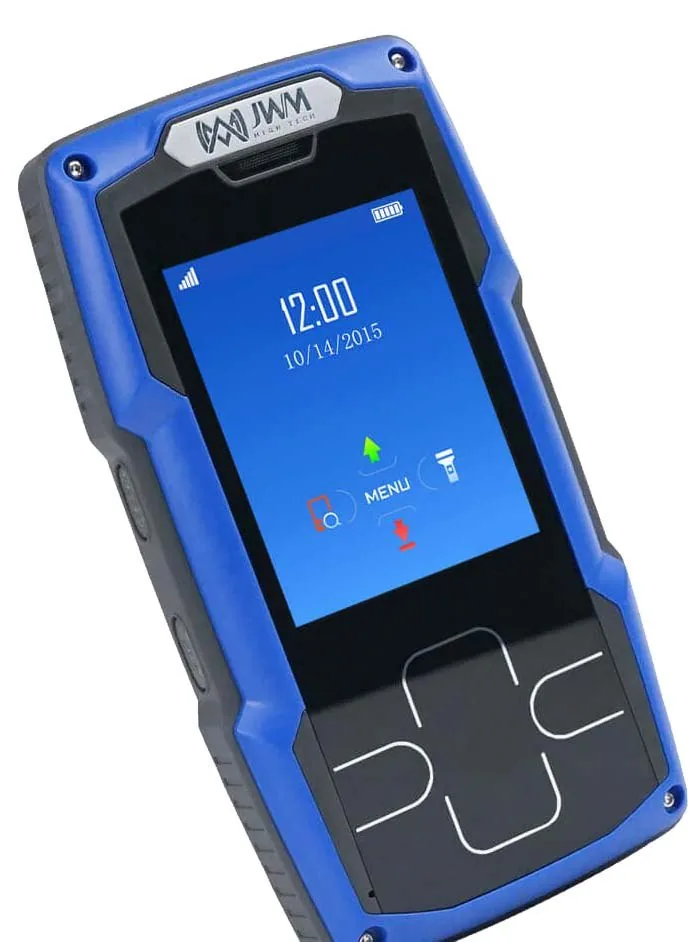
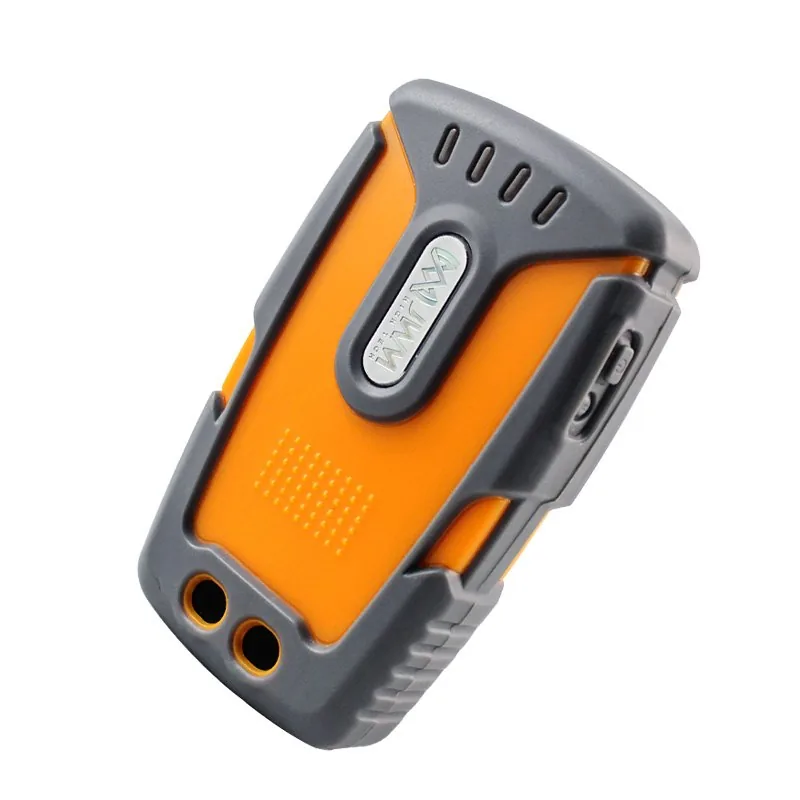
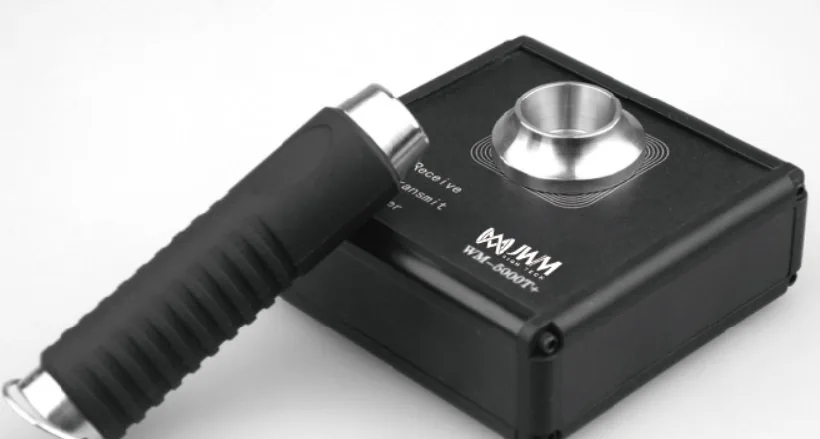
The models behind these tests
Soalan Lazim
Jawapan praktikal tentang pembaca rondaan pengawal, pemilihan dan pelancaran.
What does IP67 actually mean?
Can I use the reader in a freezer or a cold store?
The reader was dropped or soaked. How do I know it is still good?
Want the full datasheet for a model?
Tell us the site, the route length and the download routine, and we will send the datasheet and price list for the two or three models that actually fit — not the whole catalogue.
Ask for datasheet and price list